The Toronto Manleys: Morris Manley, Dolly Sterling, and Mildred “Canada’s Greatest Child Vocalist”
Origins Obscured: The Early Life of Morris Manley
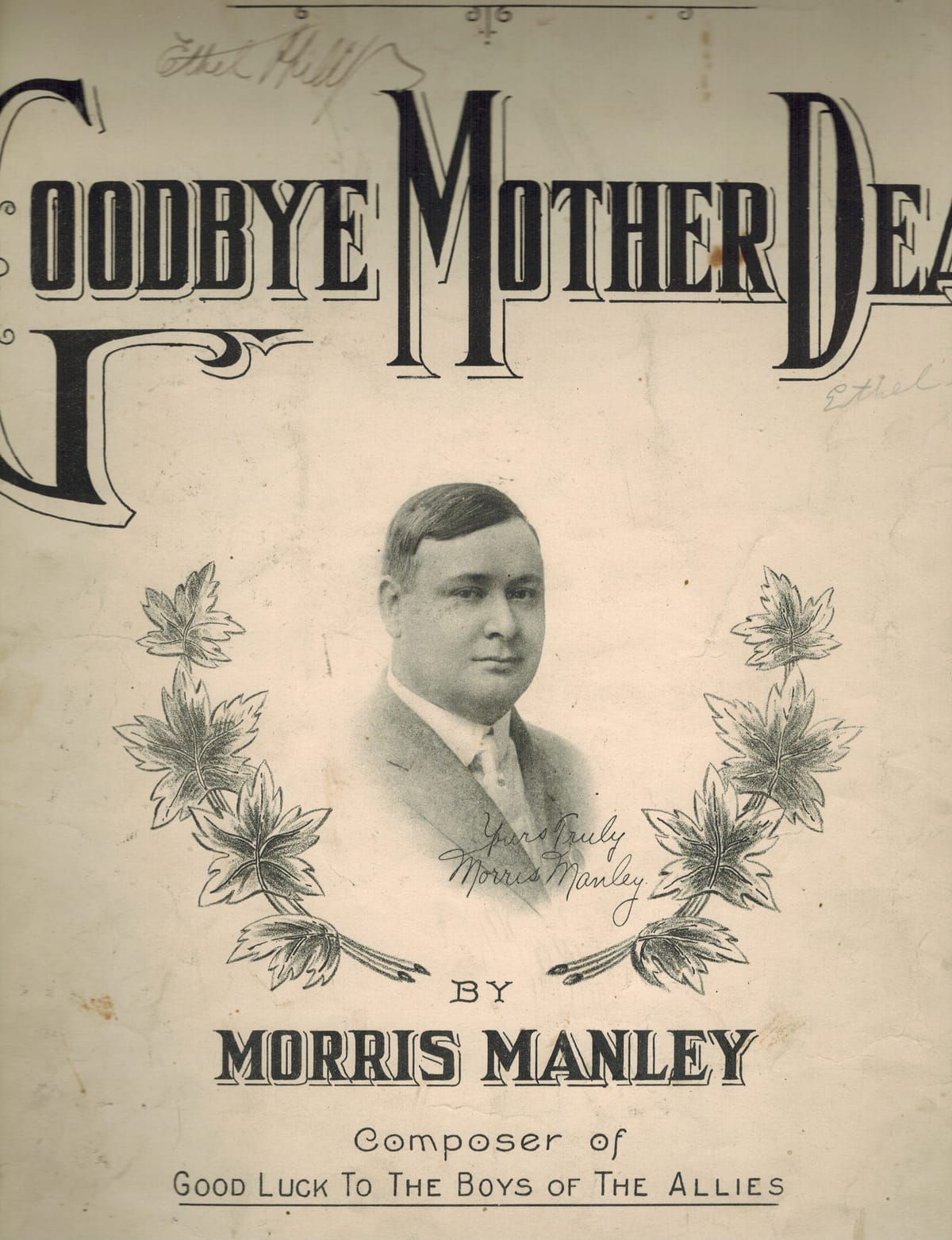
The birth of Morris Manley is itself something of a mystery, a fitting beginning for a man whose life was spent in the business of illusion and performance. The 1930 United States census records his birthplace as Chicago, Illinois, and his birth year as somewhere between 1875 and 1877. But the truth appears to be rather more complicated — and considerably more romantic.
The weight of evidence suggests that Morris was born in England around 1875–1877, possibly in the industrial heartland of Birmingham, Warwickshire, though Wales has also been suggested as a possibility. His parents were Morris Manley Senior and his wife Annie, a Welsh father and an Irish mother — a pairing not uncommon in the industrial towns of Victorian Britain, where Welsh and Irish working-class communities frequently overlapped. The quintessentially Welsh “Lloyd” appears as a middle name for his sister, offering a quiet clue to the family’s Celtic origins.
Whatever the exact circumstances of his birth, Morris, and his sister Jane Lloyd Manley (known throughout her life as “Jennie”) found themselves, at some point in the 1880s or early 1890s, in the care of Samuel and Sarah Edith Baltzer of North Ridge, in Essex County, Ontario, Canada. The circumstances that brought two English children to a rural Ontario farming community are uncertain. Their parents, Morris Senior and Annie, do not appear in Canadian records; whatever fate befell them — death, poverty, or simple abandonment — their children were left to be raised in a new country by strangers who became family.
A Windsor, Ontario newspaper of July 14, 1900, makes the situation plain: Morris Manley, it notes, was “adopted and raised by Mr. And Mrs. Samuel Baltzer.” A Windsor Star item of the same date tells us he was then living in Mount Clemens, Michigan, just across the border from Windsor and Essex County; and that “Mrs. Baltzer has not seen her brother for a number of years,” suggesting Morris had been away for some time before this reunion.
Sarah Edith Baltzer, née Johnson, had been born in Iowa in 1847 (some 30 years earlier than Morris) and she and Samuel had established themselves in the North Ridge community of Essex County. The 1891 Canadian census finds young Jennie, then 16 years of age, listed as a “lodger” in the Baltzer household, born in England, and Methodist in religion. She was not yet formally described as an adopted daughter, although clearly in the family’s care. By the time of Jennie’s marriage in 1896, however, she is recorded as the “adopted daughter of Mr. And Mrs. Samuel Baltzer.” The formalization of the relationship appears to have deepened over time.
Morris himself does not appear in the 1891 census with the Baltzers. He may still have been in England at that point, or lodging elsewhere in the region. What is clear is that by the mid-1890s he had established himself as a professional entertainer working the American Midwest. This suggests that his entry into performing began very early, perhaps as a teenager, and perhaps as a way of making his own way in the world while Jennie settled more conventionally into the Baltzer household.
What did Morris look like? The Hamilton Spectator of September 1904 offers our earliest physical description: “a big, good-natured looking comedian.” The photograph published alongside a Beloit, Wisconsin newspaper review in November 1906 shows a well-dressed young man in his late 20s with dark, somewhat curly hair, sitting in a thoughtful pose with his hand to his chin, holding what appears to be a rolled piece of sheet music. He appears compact and well-groomed, with the self-possessed ease of a man comfortable in front of a camera, or an audience. The newspaper descriptions of his performing style reinforce the physical impression: energetic, physically expressive, with a “good, clear, rich voice” that carried well in large halls. He was, in his prime, a man who filled a room.
The Making of a Performer: Kansas, Missouri, and the Medicine Show Circuit
The earliest documented record of Morris Manley as a performer comes from the Kansas City Journal of July 22, 1894, which places him performing a “tableau” called The Empty Harness alongside a partner named Burt Johnson. He would have been approximately 17 years old. It is a striking debut, not in a grand theatre, but in the rough-and-tumble world of variety entertainment that preceded vaudeville’s golden age.
By February 1895, he was working the small towns of rural Kansas with the Shaker Concert Company, a touring troupe that played Grange halls — the community meeting places of farming communities — across Johnson County. The Gardner Weekly Message of February 22, 1895, gives us our most detailed early portrait of young Morris in action:
“Morris Manley, the dialect comedian, whose equal has never been seen in Gardner. His version of an old ‘down eastern farmer’ at the circus was indeed funny, were his many specialties in black face, Irish, Dutch, etc.”
He was, even at 17 or 18, a complete entertainer — comedian, character actor, dialect specialist — performing alongside the company’s “talented pianist, Mr. James Pickens,” who could play blindfolded with gloves on his hands and a sheet over the keys.
These early Kansas dates were not glamorous engagements. The Grange halls of Johnson County were functional farm community buildings — wooden floors, kerosene lamps, rows of hard chairs filled with families who had driven in from surrounding farms. Admission was minimal or free. The Shaker Concert Company moved from town to town by whatever transport was available, more likely by wagon or local rail line than by any established theatrical circuit. Morris was learning his craft from the ground up, in the most unforgiving of schools.
These early years also brought Morris into contact with a distinctly American phenomenon: the medicine show. The Spring Hill New Era of October 3, 1895, records him performing for The Hygienic Electric Belt Specialty Company at the Grange in Spring Hill, Kansas, where he was billed as “The New York Favorite” for his comedy. The electric belt — a patent medicine device marketed as a cure for everything from nervous disorders to rheumatism — was one of the most popular quack remedies of the 1890s, with tens of thousands sold across the United States before the medical establishment finally discredited them. The medicine show format was simple: provide free entertainment to draw a crowd of farmers and townspeople, then sell the product on the strength of the goodwill generated. For a young performer without established circuit connections, it was employment, and it was training in the most demanding school imaginable — holding the attention of a skeptical, unsentimental rural audience who had come primarily for the curiosity of the thing rather than for any love of theatre.
The Paola Times of March 14, 1895, records him in another small Kansas town as a “blackface comedian” — a format that was, unfortunately, standard entertainment fare of the era, and one Morris clearly included in his repertoire alongside his Irish and Dutch dialect characters. He was building an arsenal of performance styles that would serve him for the next four decades.
How did Morris travel between these early engagements? Almost certainly by rail. The 1890s were the golden age of American railroad expansion, and even small Kansas towns were connected by branch lines to the regional network. A performer on the small-town circuit would have travelled by the cheapest available means — day coaches, sometimes overnight in the seat, luggage piled around him, moving from Gardner to Spring Hill to Paola as the bookings dictated. Later, as his career advanced and the distances grew greater, the railroad remained the essential artery of vaudeville life. The great circuits — the Orpheum, the Keith-Albee — were built as much around railway timetables as around theatrical geography. An act booked into Winnipeg one week and Houston the next was, in practical terms, spending as much time on trains as on stages. The 1940 census, found Morris and Dolly (more on Dolly and Morris’ life continues below) in their Queens apartment with no employment income, closing the book on a lifetime of railway journeys: platform after platform, town after town, the conductor calling out names that had once meant an audience and a paycheck.
By 1896, Morris had graduated to the Wonderland Theater in St. Joseph, Missouri, where the September 12, 1896, edition of the St. Joseph News-Press records him performing as a “singing comedian.” He was returning there the following August as well, suggesting he had become a regular and welcome presence. The Wonderland was a step up from the Grange halls — a proper theatre with a paying audience — and his regular bookings there indicate that he may have developed a following.
In December of that same year, 1896, his sister Jennie was married on Christmas morning in Kingsville, Ontario, to Alfred Baltzer, by the Reverend W.H. Shaw. Her new husband’s world of Essex County farms and electric plants was settling around her just as Morris’s world was expanding in the opposite direction.
By 1903, Morris was performing at the Temple Theatre in Windsor, a legitimate vaudeville venue that served audiences on both sides of the Canada-United States border, given Windsor’s position directly across the Detroit River from one of America’s great industrial cities. The Hamilton Star Theatre followed in September 1904, where the review gives us that vivid physical description of a “big, good-natured looking comedian” with a “good monologue, and a lot of parody” who had “the boys whistling the chorus of his waltz song, ‘Where the Summer Breezes Blow.’” The gallery — the cheap seats, the working-class section at the back and top of the house — responded with particular warmth: he “made a hit with the gallery boys,” the reviewer noted, a phrase that carried specific meaning. Gallery audiences were the toughest and most honest judges in the vaudeville house. They paid the least and expected the most, and they had no patience for pretension. Morris, the former medicine show entertainer from the Grange halls of Kansas, knew how to talk to them.
The Windsor Star of June 27, 1910, informs us that Morris by this point “owned a fine little roundabout automobile,” a light, open two-seat motorcar, very much a fashionable and somewhat expensive possession at the time. It suggests a man of comfortable means, pleased with his success and happy to show it. Whether he used the automobile for short local journeys or simply as a status symbol is not recorded, but the image of Morris Manley — the orphaned English boy from Essex County, the former medicine show comedian — motoring through Windsor in his own car has a certain satisfying completeness to it.
Dolly Sterling: Partner in Life and Art
At some point in the early years of the 20th century, Morris Manley acquired a partner who would prove as central to his story as his own talent. Dorothy, known always as “Dolly,” was born in Des Moines, Iowa in October 1888, the daughter of Sidney Marshall. She was perhaps a decade younger than Morris, a gap that would show up in later census records with some awkwardness, but which apparently presented no obstacle to either romance or professional partnership.
She performed under the name Dolly Sterling. Whether Sterling was her actual maiden name, a stage name, or some combination, is a question the record does not fully resolve. Her death certificate gives her maiden name as Marshall, but a formal US copyright filing from 1909 names her as “Dolly Sterling” in a legal context, suggesting the name may have had genuine documentary standing. It is worth noting that a Miss Lulu Marshall, billed as a contralto, appears alongside Morris in a Lansing, Michigan newspaper notice of July 20, 1905. Whether Lulu was related to Dolly, perhaps a sister who performed with Morris in the period before Dolly joined the act, or maybe a stage name of Dolly herself, remains an intriguing unanswered question.
What did Dolly look like? The Beloit, Wisconsin newspaper photograph of November 1906 shows a young woman with abundant dark curly or wavy hair, handsome rather than conventionally pretty, with a direct and confident gaze, the look of someone entirely at ease being photographed. The Pittsburgh Post-Gazette of March 30, 1919, published a separate theatrical portrait of her performing independently in Pennsylvania, showing her with an elaborate up-swept hairstyle fashionable for the era, well-dressed and poised. The Muskegon Chronicle of 1908 called her “chic and pretty,” a reviewer’s shorthand for a woman who carried herself well and knew how to dress for the stage.
What is beyond doubt is that by November 1906, Morris and Dolly were performing together at the Bijou Theatre in Beloit, Wisconsin, billed as “Manley and Sterling.” By May 1907, they were at the Family Bijou in Ann Arbor, Michigan, where the “Family” designation indicated wholesome, all-ages programming, confirming their act was considered respectable entertainment suitable for women and children, as well as men.
Their act centred on a comedy sketch that Morris had written himself: Kid Hickey, A Story in Slang, a romantic comedy playlet set in Happy Hollow, Hot Springs, Arkansas, in which a boxer in training saves the life of an heiress and ultimately marries her. The humour came from the contrast between rough boxing slang and the romantic dramatic situations. Morris almost certainly played the pugilist and Dolly the heiress. The Muskegon Chronicle of November 3, 1908, gives us the most detailed contemporary account of their act:
“Miss Sterling is chic and pretty and Manley’s command of slang is something to conjure spirits of Bob Fitzsimmons and John L. Sullivan with.”
The reviewer noted, with a critic’s frankness, that “if Dolly Sterling would only use her pretty voice a little more the audience would be better pleased,” suggesting she was playing the comedy rather than the singing in this particular piece.
On the same Muskegon Bijou bill were Happy Bill Briggs, described as “a good old minstrel comedian with a line of songs,” and Ella LePage, a performer known for impersonations, whose style the critic considered slightly dated. The Brobsts, a family act featuring Mr. Brobst as “a fine pianist and cellist,” performed a piece entitled A Musical Breeze. These were the working companions of Morris and Dolly’s professional life: a shifting roster of specialty acts and comedy performers, thrown together by circuit bookings, shared dressing rooms, and train compartments across the Midwest.
The same review offers a valuable profile of Morris at this stage of his career:
“A vaudeville writer and song composer who is also a capable actor is Morris Manley… Mr. Manley is the composer of almost a score of popular songs.”
Among the songs listed were “Automobiling With Molly,” “Pansy Blossom,” and “If I Could Only Have My Way” — all predating the WWI patriotic material that would make his name in Canada.
Kid Hickey sustained them for years. It played Winnipeg’s Dominion Theatre in February and March 1909, a gruelling engagement in the dead of a prairie winter for a couple accustomed to the relative warmth of the American Midwest. Winnipeg was the major entertainment hub of the Canadian prairies, and the Dominion was its premier vaudeville venue. The Manitoba Morning Free Press described Kid Hickey as a “playette” and the Winnipeg Tribune elaborated on its plot. Sharing the Dominion bill during this engagement were the Marriott Twins, a bicycle spinning and juggling act — a classic vaudeville specialty that would have provided vivid visual contrast to Morris and Dolly’s comedy playlet.
How did they get to Winnipeg? Almost certainly by rail; the Canadian Pacific line from Chicago through the Twin Cities and across the prairies, a journey of many hours in a day coach or, if the booking warranted it, a sleeping car. February on the prairies meant temperatures that could fall to -40° C, and train delays from blizzards were a routine hazard of prairie touring. The audiences that turned out for Dominion Theatre shows in such conditions were hardy souls. Winnipeg residents who took their entertainment seriously enough to venture out in Canadian winter weather, dressed in their best, for an evening of professional vaudeville.
Kid Hickey next played Houston, Texas in June 1910 — the opposite climatic extreme, summer in the deep south — and Lima, Ohio’s Orpheum in October of the same year. The Orpheum circuit was one of the most prestigious vaudeville operations in North America, eventually encompassing 45 theatres in 36 cities. Playing an Orpheum house meant Morris and Dolly had been assessed and approved by the circuit’s booking agents — a mark of professional standing that opened further doors. The Orpheum’s audiences tended to be middle-class and family-oriented. The circuit’s founder had aimed to make vaudeville “suitable for refined young ladies,” and the standard of decorum in Orpheum houses was considerably higher than in the rougher variety theatres.
By 1909, they had also copyrighted a second piece, The Picture Man, a “dramatic composition in one act,” registered with the US Copyright Office under both their names — “Morris Manley & Dolly Sterling, Des Moines, Ia.” — confirming Dolly as a genuine creative collaborator, not merely a performer. The copyright was registered from Des Moines, Dolly’s hometown, suggesting they were visiting her family — perhaps the same “Mr and Mrs Marshall of Demoine Iowa” [sic] mentioned in a July 1909 Windsor Star notice — when the paperwork was filed.
Dolly Alone: The Pennsylvania Interlude
There is a chapter in Dolly’s story that sits slightly apart from the Manley family narrative, and it deserves its own consideration.
By 1917 or thereabouts, Dolly appears to have been working independently, touring without Morris, and without daughter Mildred (about whom much can be found below). The Pittsburgh Post-Gazette of March 30, 1919, places her at the Academy Theatre in Pittsburgh, Pennsylvania, performing as “Dolly Sterling,” her professional name, not her married one. She was not billed alongside Morris. She was performing alone.
What was happening in the Manley household at this moment? Morris was active in Toronto and Halifax, composing and performing his wartime material. Mildred, at approximately ten or eleven years old, was at the height of her child performer career in Toronto, her bookings managed from College Street. The family enterprise, in other words, had divided into three streams: Morris the composer-performer, Mildred the child star, and Dolly — the pivot point of the whole operation — apparently pursuing her own performing career in Pennsylvania while also managing her daughter’s bookings, and accompanying her on the Toronto concert circuit.
This is speculation, but informed speculation. A woman of Dolly’s abilities — pianist, actress, comedian, co-author of a successfully touring playlet — would not have been content to sit at home on College Street managing correspondence while the stages of North America called. The Pittsburgh engagement was almost certainly not her only independent booking; it is simply one of the many that has surfaced in the surviving record. One finds other Pennsylvania dates, other theatres, other cities where Dolly Sterling appeared without the “and Morris Manley” billing that had defined her professional identity for a decade.
What did she perform alone? The Academy Theatre was a legitimate vaudeville house, and Dolly’s established reputation would have secured her a reasonable billing. She may have reprised elements of the Manley and Sterling act — comic songs, perhaps a solo version of some of their material — or she may have developed something entirely her own. A Pittsburgh portrait shows a confident, well-turned-out woman who knows exactly what she is doing in front of a camera. One suspects she knew exactly what she was doing on a stage, too, with or without her husband in the wings.
The question of why she went to Pennsylvania specifically, rather than touring with the Canadian circuit alongside Morris, or staying in Toronto with Mildred, may have a simple answer: the bookings were there, and she took them. Or there may be a more personal dimension to her independent touring that the surviving record simply does not illuminate. Marriages under the pressures of professional entertainment life, with its constant travel and financial uncertainty, were not always straightforward, and the distance between a wife performing in Pittsburgh and a husband composing patriotic songs in Toronto invites reflection, even if it defies definitive interpretation.
What we can say with confidence is that Dolly was, throughout her life, a working professional in her own right, not merely an appendage to Morris’s career, but a performer and creator who also happened to be his wife, and his daughter’s accompanist and manager.
“Canada’s Greatest Child Vocalist”: The Making of Little Mildred
Mildred Manley arrived in a world already defined by performance. Her father was a touring comedian and songwriter; her mother was his professional partner and a pianist of genuine ability. The stage was, quite literally, their home.
She appears first in the records as a two-year-old, named in a Windsor Star social notice of June 22, 1910:
“Mr and Mrs Manley and daughter Mildred have arrived in Kings[ville] for a few weeks vacation.”
One imagines the small family arriving at Aunt Jennie and Uncle Alf Baltzer’s home on Pearl Street in Kingsville, during a brief respite from the touring circuit, the toddler perhaps unsteady on her feet in the summer heat of Essex County.
What did Mildred look like? Every contemporary source agrees on one point: she was blonde. The Halifax Evening Mail of 1919 describes her as being “of the purely blonde type.” A 1927 New York review makes an arch reference to “gentlemen prefer blondes.” A 1928 Rome, New York review describes her simply as “blond and low down.” Her sheet music covers — the one for “I Want My Daddy” most famously — depicted her as a pretty, fair-haired child with an open, appealing face. As an adult performer she was described as “dainty” and “beautiful” in one Mount Vernon advertisement, while reviewers noted her “debonaire demeanor” and physical charisma. A 1925 Brooklyn review coined the comparison to Eva Tanguay, not for her blonde hair but for her explosive energy and uninhibited stage presence. Mildred was, by every account, a performer who lit up a room.
By 1914 or 1915, the family had settled in Toronto, where Morris found a new purpose for his talents. The First World War had transformed the cultural landscape of English Canada. Patriotic concerts, recruiting rallies, fundraising events, fuelled the demand for entertainers willing to serve the cause was enormous, and Morris, the adopted son of English immigrants with a flair for emotional songwriting, was perfectly placed to supply it.
He established himself initially at 83 Victoria Street, Toronto, and later at 1044-1046 College Street — a working and middle-class residential street in the west end of the city, a short walk from the Doric and Park Theatres at Bloor and Lansdowne. From these addresses he published songs and managed a remarkable family enterprise. The Star Weekly of November 27, 1915, ran a professional advertisement that captures the moment precisely:
“Little Miss Mildred Manley, the wonderful child vocalist and entertainer who has captivated Toronto audiences by her clever work. This little girl has been labeled by press and public ‘Canada’s Greatest Child Singer.’ In three weeks she made the latest patriotic song, ‘Good Luck to the Boys of the Allies,’ the biggest hit of the year. Under personal direction of M. Manley, 83 Victoria street. Main 1522. Open for concert and banquet engagements.”
Morris was, in the language of the modern entertainment industry, his daughter’s manager. He had created the product, written the material, and was now actively marketing her. It was the medicine show business model, elevated to a considerably higher plane.
The Toronto Star of December 31, 1915, places seven-year-old Mildred at the Hippodrome, one of Toronto’s major entertainment venues, for a Sportsmen’s Patriotic Concert. It also featured baritones, sopranos, a cellist, a violinist from the prestigious Keith circuit, military bands, and a nationally known preacher, the Reverend S.B. Nelson of Hamilton. The ticket prices were graduated: reserved seats at 50 cents, 75 cents, and one dollar, with rush seating at 25 cents. These were respectable prices for a middle-class Toronto audience, the kind of audience that filled Massey Hall, attended Sons of England concerts, and sent their sons to the 208th Irish Battalion.
Her accompanist at many of these early Toronto events was Charles Musgrave. By October 1916, the Toronto Star identified Musgrave specifically as a “popular accompanist” appearing with Mildred at a Sportsmen’s Farewell at Oddfellows’ Hall on College Street, just steps from the family home at 1044-1046 College Street. He “kindly volunteered his services” for the Hippodrome patriotic concert of December 1915 as well, alongside Bandmaster F. Reeves. These were men who believed in the cause, as well as the child performer they were accompanying.
The scale of Mildred’s public profile is perhaps best captured by the Massey Hall concert of October 1916. Massey Hall opened in 1894 as a gift to the people of Toronto from the industrialist Hart Massey. Built in a late Palladian and Moorish Revival style with outstanding acoustics that would later make it famous as “Canada’s Carnegie Hall” and the oldest continuously operating concert venue in North America, it seated over 2,000 people. At the Sons of England Annual Grand Concert, “over two thousand people joined in the chorus of ‘I Want My Daddy,’ as sung by Little Mildred Manley.” The song’s theme — a young girl missing her father away at war — performed by an actual young girl at the height of the war’s casualties — was devastating in its emotional sincerity. The hall that would later host Glenn Gould’s debut, Oscar Peterson’s early performances, and the legendary 1953 jazz concert of Charlie Parker, Dizzy Gillespie, Bud Powell, Charles Mingus and Max Roach, had been moved to mass communal singing by an eight-year-old girl from College Street.
By 1918, Toronto’s movie theatres had discovered her commercial value. The Star Weekly of July 27, 1918, records her appearing as an “Extra Added Attraction — the entire week” at both the Doric Theatre (Bloor and Lansdowne) and the Park Theatre (Bloor and Gladstone), performing live as a supporting act to films starring Jack Pickford, the Toronto-born younger brother of Mary Pickford. The pairing of live child performer and silent film was a standard commercial strategy of the era, and the fact that the Toronto theatres used Mildred repeatedly suggests she was a genuine draw.
The Halifax Evening Mail of September 27, 1919, gives us a sense of how Mildred was regarded beyond Toronto. Advertising her appearance at the Big Exhibition in Halifax, the paper quoted three press sources: the New York Variety called her “a wonderful entertainer” with “dialect stories” that were “great” and “a voice as strong as a girl twice her age”; the Toronto Daily Star declared her “the greatest child entertainer ever seen in Toronto”; and the Detroit Journal labelled her “The Human Doll,” noting that she was “of the purely blonde type” and that “the simple word ‘wonder’ positively applies to her and her acting.” She was eleven years old. She had been performing professionally, in major venues, for at least four years.
Morris himself was not merely the man behind the piano. The same Evening Mail ran a separate notice for his own Halifax appearance, billing him as a “Great Comic Entertainer” and “Canada’s Greatest Song Writer,” noting that the New York World had praised his “good, clear, rich voice,” and that audiences were “calling for more when his repertoire was exhausted.” Father and daughter were both in Halifax in the autumn of 1919, appearing on different bills in what had clearly become a well-organized family entertainment enterprise: Morris composing, publishing, and performing; Dolly accompanying and managing bookings; and Mildred the star attraction.
A May 1919 advertisement in the Star Weekly, which ran for at least two consecutive weeks, makes the business arrangement explicit:
“Little Mildred Manley, Phenomenal Child Vocalist and Entertainer. Can be engaged for Concerts, Garden Parties, Fall Fairs, etc. For terms, address Mrs. Morris Manley, 1046 College Street, Toronto. Phone Parkdale 5834.”
The Star Weekly of December 15, 1917, offers one domestic glimpse into Mildred’s Toronto life: she appears on the membership list of a children’s club — most likely associated with the newspaper itself — at her address of 1044 College Street, listed simply as “Mildred Manley, aged 10.” No billing. No “Canada’s Greatest Child Vocalist.” Just a ten-year-old girl joining a newspaper club, like any other child on the street.
Transition: From Toronto Child Star to New York Performer
At some point after 1919, the Manley family left Toronto for New York. The precise date of the move is not recorded, but by 1930 they were firmly established in Queens, and the trajectory of Mildred’s career in the mid-1920s suggests the transition was complete by 1924 at the latest.
The entertainment world Mildred entered as a young adult was very different from the patriotic concert halls of wartime Toronto. Vaudeville was changing. The rise of cinema, the spread of radio, the relaxation of postwar social norms were all reshaping popular entertainment. And Mildred was changing too, from the angelic child performer of the war years into something altogether more exciting.
The Daily Freeman of Kingston, New York places her dancing at the Kingston Opera House as early as November 1924. By the 1924–1925 season she had appeared in Innocent Eyes at the Winter Garden Theatre on Broadway — one of New York’s most storied theatrical venues, built by the Shubert brothers in 1911 on the site of William K. Vanderbilt’s old American Horse Exchange. This was where Al Jolson had made his Broadway debut on opening night, and where West Side Story, Funny Girl, and Cats would later play to generations of New York audiences. Innocent Eyes was a Shubert production, and Mildred, at about 16–17 years of age, had appeared in it as a star. The Brooklyn Daily Times of October 7, 1925, confirms the engagement, describing her as having “starred last season in ‘Innocent Eyes’ at Shubert’s Winter Garden,” while noting she was now appearing on a high-grade vaudeville bill alongside performers from the prestigious Keith circuit.
That same 1925 Brooklyn review gives her a new nickname — “the miniature Eva Tanguay.” Tanguay was the most uninhibited, energetic, and famously explosive star in vaudeville history, known as “The I Don’t Care Girl,” a performer of such volcanic stage presence that comparisons to her were among the highest compliments the vaudeville world could offer. The reviewer was not suggesting a physical resemblance, but rather that she possessed the same quality of raw, unrestrained performing energy — the ability to fill a stage and hold an audience by sheer force of personality. To be called, at age 17, a miniature version of the greatest female vaudevillian of the age was no small thing.
By February 1927, she was performing on the same bill as Frank Farnum (born William Smith in Boston in 1878), a vaudeville veteran who had started his performing career at age twelve and had appeared on Broadway in Ziegfeld revues before eventually turning to Hollywood. A reviewer described Mildred’s performance that evening with genuine admiration: she “demonstrates why fer gentlemen pre' blondes… she’s not a comer. No, suh! Mildred has arrived.” The nickname “the ball of fire” had attached itself to her.
In April and again in autumn 1928, she held a residency at the Rio Rita Restaurant in Mount Vernon, New York (“First Street at Fifth Avenue Bridge,” described as “Mount Vernon’s New and Beautiful Restaurant”) where she was billed as “Star of ‘Innocent Eyes’” and performed “every evening this week and next.” The Knickerbocker Orchestra provided the house music. The Mount Vernon Argus ran her photograph. At the Rio Rita, the admission was through the restaurant itself; a Sunday dinner for $1.25 brought the audience that heard Mildred perform — a comfortable price for a middle-class establishment offering filet of sole, roast milk-fed chicken, and Italian cream cake alongside the entertainment.
By December 1928, the Rome, New York Daily Sentinel had reviewed her performing the blues: W.C. Handy’s “St. Louis Blues,” delivered in a voice that could capture the specific agony of sitting “in a jailhouse with my back to the wall.” The reviewer called her “blond and low down… fascinating without being too vulgar,” a careful qualifier that tells us something about the territory she was now working, the borderland between respectable entertainment and something rather more charged. She was 20 years old, and had travelled a considerable distance from the patriotic parlour songs of College Street.
The following year, in October 1927, she gave birth to a daughter, Linda.
Mildred, Richard, and Linda
It was somewhere in this world of late-1920s New York entertainment that Mildred Manley encountered Richard Giannone. Born in the Bronx in 1903 (appearing in some records as Riccardo or Riccardi, reflecting his Italian family heritage) Richard was a musician working the New York club circuit. His 1942 draft card describes him as 5’ 6” (168 cm) tall, 135 pounds (ca. 61 kg), blond with hazel eyes — a slight, fair-complexioned man, surprisingly similar in colouring to Mildred herself. By 1942 he would be playing at Minsky’s 51 Club at 51 West 52nd Street, the nightclub operation of the famous Minsky burlesque family, situated on “Swing Street,” a stretch of 52nd Street between Fifth and Sixth Avenues that was the beating heart of New York’s jazz and nightclub scene in the early 1940s.
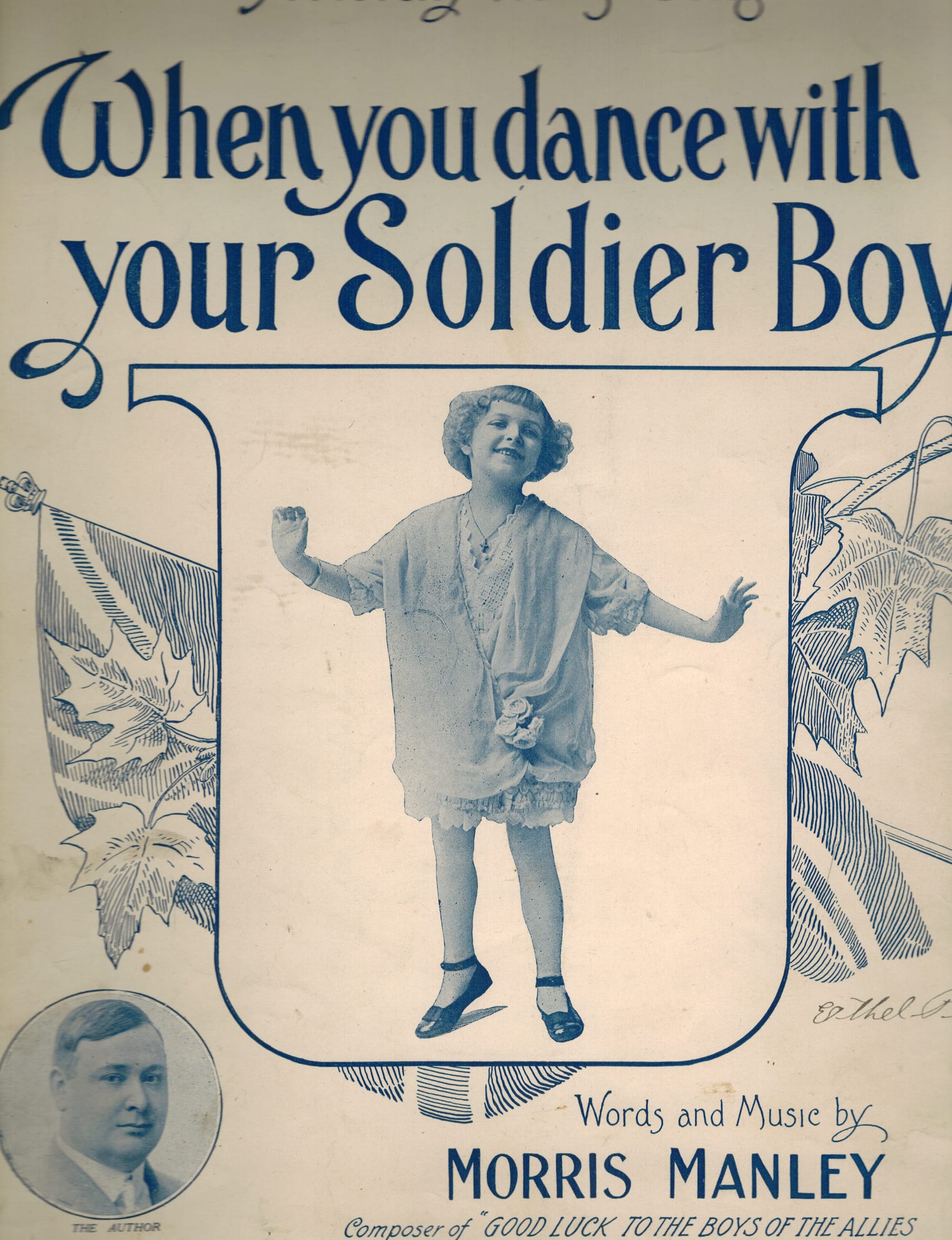
Their daughter Linda was born on October 26, 1927, in Manhattan. By 1930, she appears in the Manley household at 27th Street, Queens, listed as “Linda Lewis,” age two, alongside Morris, Dolly, and Mildred, who is herself recorded as “Mildred Lewis, age 21, first married at age 18.” Whether “Lewis” was a husband’s name, a middle name used for documentary purposes, or some other arrangement remains unclear. What is clear is that Richard Giannone was not part of the household, and that Linda, for the first years of her life, was raised within the Manley family in Queens.
The 1930 census gives us a vivid domestic snapshot: Morris, now in his mid-50s, listing his profession as vaudeville performer; Dolly, about 41, doing the same; young Mildred with her daughter; and baby Linda. They rented their home. The great vaudeville circuit that had carried Morris and Dolly from Beloit to Winnipeg to Houston was effectively dead, killed by the talkies and radio. The census of 1940 found them still in Queens, at 32-48 34th Street, with Dolly now listed as head of household. Both she and Morris gave “vaudeville actor” as their occupation despite having had no work in 1939. Their income came “from other sources” — savings, perhaps, or some form of entertainment industry residuals. Both had completed only eighth grade, a fact the census dutifully recorded alongside their glamorous-seeming profession.
It is worth pausing here to consider what that 1940 census entry actually represents: two people in their 60s, living in a rented Queens apartment, clinging to professional identities about which the world no longer cared. The Orpheum circuit was long gone. The Dominion Theatre in Winnipeg had stopped booking vaudeville acts. The Bijou theatres of Beloit and Muskegon and Ann Arbor had become cinemas. Kid Hickey, A Story in Slang had not been performed in 20 years. And yet Morris and Dolly Manley remained, in their own understanding of themselves, vaudeville performers. It was who they were.
Dolly Marshall Manley, at age 54, died on October 22, 1943, at St. John’s Hospital in Queens, of ulcerative colitis leading to a ruptured sigmoid colon and generalized peritonitis — a painful death. Her death certificate contains one puzzling detail: although her parents were said to have been born in Iowa, it states she had been in the United States for only 18 years. If accurate, this would imply she spent a substantial portion of her life in Canada. Perhaps the Toronto years were longer or more significant to her official residency status than previously appreciated. She was buried at Kensico Cemetery in Valhalla, New York. Her husband Morris, still alive, served as her executor.
Morris himself died, tentatively, around 1947 in New York — the date remains unconfirmed in the documentary record. If accurate, he outlived Dolly by only a few years, dying as vaudeville’s last audiences were themselves aging out of existence.
Mildred Manley died on February 3, 1949, in Manhattan. She was approximately 40 years old. Her funeral was held four days later at a Brooklyn funeral home chapel. Brooklyn was where Jennie and Alf Baltzer had spent their honeymoon in 1896, and where Mildred had performed on vaudeville bills as a young woman. She was survived by her daughter, Linda, then 21 years old.
Linda’s Story: A Life Beyond the Stage
Linda Giannone Thompson, who had begun her life as Linda Lewis in the Manley family household in Queens, built her life far from the world of vaudeville and Broadway. She married Dudley Thompson on June 6, 1951, at Highland Farms, New York. By April 1955, she and Dudley, a Lieutenant in the US military, arrived at New York from Frankfurt, Germany, on a Seaboard and Western Airlines flight, accompanied by their approximately one-year-old son John R. Thompson. Dudley’s military service accounts for Linda’s eventual burial at the United States Military Academy Post Cemetery at West Point, New York.
In the 1990s, Linda and Dudley were living in the Maryland suburbs of Washington DC (Silver Spring, Rockville, North Potomac) suggesting a life connected to the capital’s government and military world. She died on May 13, 2023, survived by her son John and his wife Lisa, and a daughter Ann and her husband Benjamin. She was 95 years old, a remarkable longevity that took her from the Queens household of her grandfather Morris Manley, “Canada’s Greatest Song Writer,” all the way to the 21st century.
Her father Richard Giannone had lived a parallel but separate life. He married Angela Spano in the Bronx on June 29, 1935, and they had a daughter, Amelia, born around 1940. Richard identified himself as a musical director in the 1950 census, though he was then unemployed and seeking work — a familiar story in an entertainment industry that had been restructured by television and the decline of the big band era. He and Angela eventually moved to the Chicago suburb of Morton Grove, Illinois, where Richard died on October 17, 1986. Angela, born around 1913, was a former dressmaker who had kept the family afloat during Richard’s lean years; she lived on until January 12, 2013, dying at approximately 99 years of age. Their daughter Amelia predeceased her mother, dying in Chicago in 2007.
The Baltzer Connection: Family in Essex County
While Morris was building his career across the stages of North America, his sister Jennie lived a quieter but no less full life in Kingsville, Ontario. Her 1896 Christmas morning wedding to Alfred Baltzer (son of Michael and Susan Baltzer of Arner) had been reported in the Kingsville Reporter with the warmth of small-town journalism:
“We extend our hearty congratulations to Alfred Baltzer & Miss Jennie Manley who were united & made ‘one’ on Christmas morning… They are spending their honeymoon in Brooklyn N.Y. & on their return will reside in Gosfield South near Kingsville.”
Brooklyn again — a curious thread that connects the Manley family’s story at multiple points.
Alfred worked for many years as a master mechanic and electrical engineer at the Kingsville electric light plant. He and Jennie had at least five children: Edith (who married Earl Murtaugh), Maurice, Lloyd, Karl, and Edwin Carlton. The name Maurice (an alternate form of Morris) given to one of Jennie’s sons suggests a warm affection for her brother, whether biological or adoptive. Alfred died on January 8, 1943, in Kingsville, just nine months before Dolly Manley’s own death in Queens. Jennie survived him by more than a decade, dying on July 6, 1955, in Essex County, the last survivor of the generation that had come, somehow, from England and Wales to the farms of southwestern Ontario.
A 1931 Kingsville anniversary notice describes the Baltzers as pillars of their community: active in the Masons, the Eastern Stars, the Odd Fellows, the Order of the Eastern Star, and the United Church. Alfred and Jennie had spent 35 years building a life together in the same small county where they had married on Christmas morning in 1896. One wonders whether Morris, in his years of touring, ever came back to Kingsville to see them; almost certainly he did, given the pattern of visits documented in the Windsor Star through the first decade of the century. The adopted English boy and his sister had taken very different roads through life; but the roads had not, it seems, taken them very far from each other.
A Life in Songs: The Morris Manley Catalogue
Across his career, Morris Manley composed and copyrighted at least 17 known works, a figure that almost certainly understates his actual output, given that many pieces from his early career may never have been formally copyrighted or have survived in accessible archives.
The earliest documented composition is The Ottawa Fire (1900), published by R.S. Williams & Sons of Toronto (one of Canada’s most established music publishers), a descriptive piece in the popular genre of topical songs about current events. By 1901 he had copyrighted A Funny Affair, a one-act comedy co-written with a collaborator named Ivy Rose, and registered from Chicago. The waltz “Where the Summer Breezes Blow” had audiences in Hamilton whistling the chorus in 1904. “You’ll Have to Show Me, I’m from Missouri” played on the famous state motto, reflecting his deep familiarity with the American Midwest. “Pansy Blossom,” “If I Could Only Have My Way,” and “Automobiling With Molly” were all cited as established hits by 1908.
The WWI period produced his most celebrated work. Good Luck to the Boys of the Allies (1915) was turned, in three weeks, into “the biggest hit of the year” through Mildred’s performances. “I Love You Canada” (1915), co-written with Kenneth McInnis, was one of the more overtly patriotic pieces. “I Want My Daddy” (1916) brought 2,000 people to their feet at Massey Hall. “What the Deuce Do We Care for Kaiser Bill?” (1917) captured the defiant home front spirit of its moment. Later came “Up in the Air Over There” (1918), “Hello Canada!” (1919), and “The Missus and I and the Baby” (1919), the last of which seems to smile warmly at his own domestic life.
The Toronto Public Library’s Digital Archive holds physical copies of six of these compositions, and the Wikisource platform has transcribed several of the lyrics. They await the researcher who will give them the full attention they deserve.
The Supporting Cast: A World of Performers
The Manleys did not work in isolation. Around them, on every stage and every circuit, moved a world of professional entertainers who shared their billing sheets, their dressing rooms, their railway carriages, and their professional lives. Some were footnotes; a few were famous.
Charles Musgrave appears as Mildred’s accompanist at multiple Toronto events in 1915 and 1916, described as “the popular accompanist,” a man sufficiently well-known in Toronto musical circles to be identified by name in press notices. His family firm, Musgrave Bros., printed Morris’s sheet music, and the relationship between the Manleys and the Musgraves was clearly close, personal, and professional in equal measure.
The Marriott Twins, bicycle spinners and jugglers, shared the Dominion Theatre bill with Morris and Dolly in Winnipeg in February 1909. Their athletic specialty act provided vivid contrast to the romantic comedy of Kid Hickey. Such variety of tone and format was the essential grammar of vaudeville programming: the audience should never be asked to feel the same thing twice in succession.
Frank Farnum, born William Smith in Boston on June 5, 1878, and performing under his stage name from at least his early 20s, shared a New York bill with Mildred in February 1927 when she received the “ball of fire” review. Farnum had begun his vaudeville career at age twelve, appeared on Broadway in Ziegfeld revues in 1921, and briefly married the silent film actress Alma Rubens. By the time he and Mildred shared a stage he was approaching 50 years of age and transitioning from vaudeville headliner to Hollywood character actor — a journey that would eventually accord him the distinction of appearing in more Academy Award Best Picture winning films than any other performer in Hollywood history, including roles in All About Eve, Sunset Boulevard, and The Apartment. He died of cancer in 1961 at the Motion Picture and Television Country House in Woodland Hills, California.
Jack Pickford, born John Charles Smith in Toronto on August 18, 1896, was the younger brother of the silent screen goddess Mary Pickford. His films were paired with Mildred’s live performances at the Doric and Park Theatres in July 1918. It is a curiously historical conjunction that a Toronto-born Hollywood star’s films were being shown in Toronto movie houses at which a Toronto-raised child performer appeared live on the same bill. Pickford had been given his start in Hollywood by his famous sister, appearing in over a hundred films and achieving genuine star status with his portrayal of Tom Sawyer in 1917. But his life was marked by tragedy and dissipation: his first wife, actress Olive Thomas, died in Paris in 1920 after ingesting a poisonous substance; his subsequent marriages to Broadway star Marilyn Miller and actress Mary Mulhern both ended in divorce; and by the late 1920s alcoholism and the transition to sound pictures ended his career. He died in Paris on January 3, 1933, at 36 years of age, at the same American Hospital where Olive Thomas had died 13 years before. He has a star on the Hollywood Walk of Fame.
The Reverend S.B. Nelson of Hamilton — described as “known all over Canada as a strong, virile speaker,” shared the Hippodrome bill with Mildred in December 1915 — was pressed into service as a recruiting orator, his patriotic rhetoric providing the spoken-word frame around Mildred’s musical performance. Miss Van Loon and her Holland Girls String Orchestra, possibly a Dutch immigrant ensemble or simply a Dutch-themed act capitalizing on the visual novelty of an all-female string orchestra, appeared with Mildred at Scarborough Beach in May 1916. Miss Esther Pugsley, soprano, appeared alongside Mildred and Dolly at the Streetsville garden party of June 1919. She was one of the countless local musicians and performers who populated the concert circuit of small-town Ontario without ever achieving wider fame. Will J. White and Jules Brazil appeared at the same event, similarly undocumented beyond this single notice.
And somewhere in the background of all these Toronto years stands Miss Lulu Marshall, contralto, who appeared alongside Morris at the Bijou in Lansing, Michigan, in July 1905, a year before Dolly first appears in the documented record. The Marshall surname she shares with Dolly’s family invites speculation. Was she Dolly’s sister, a family connection through whom Morris first met the woman who would become his partner and wife? It is possible. It may be a coincidence of surnames. Like so much in this story, it is a question the surviving record declines to fully answer.
Reflections: The Family at the Curtain
What are we to make of the Manleys?
Morris Manley arrived in Canada as an orphaned or abandoned English child, found a home with farming people in Essex County, and transformed himself — through will, talent, and decades of practice in medicine shows, Grange halls, minor theatres, and finally the great vaudeville circuits of North America — into “Canada’s Greatest Song Writer.” His songs inspired 2,000 people to sing together at Massey Hall. His daughter’s voice carried them.
Dolly Sterling Manley sits at the piano in the background of many of these moments — the accompanist, the booking agent, the business manager, the co-author of Kid Hickey, the woman who managed the enterprise from College Street while Morris composed and Mildred performed, and who also, on her own terms, took herself to Pittsburgh and other Pennsylvania stages, reminding the world that she was a performer in her own right. History has been unkind to her, as it so often is to the women who made things work behind the scenes.
And Mildred — the “Human Doll,” the “ball of fire,” the blonde child who sang about missing her daddy to thousands of weeping strangers at Massey Hall, who grew up to deliver the blues in New York nightclubs and perform works by W.C. Handy, while the audience called her low-down and fascinating — is perhaps the most poignant figure of all. She was marketed as a wonder from the time she could walk; she was placed on Massey Hall’s stage at eight years of age to make audiences weep; her face appeared on sheet music covers before she was old enough to understand what any of it meant. That she emerged from that childhood to build a genuine adult career, to be reviewed seriously on her own terms, to be described as having “arrived,” rather than merely being promising, is itself a kind of triumph.
She died, at about 40 years of age, in Manhattan in February 1949, and was buried from a Brooklyn chapel four days later. Her parents were already gone. Her daughter Linda was 21 years old, and would go on to live another 74 years, eventually dying in 2023 and buried at West Point — a long, long way from College Street, Toronto, and the piano at which Dolly Marshall Manley once sat, accompanying her extraordinary daughter into the light.
The curtain, when it finally fell, fell quietly.
This biographical essay was compiled from primary sources, including US and Canadian census records, newspaper archives from the Toronto Star, Globe and Mail, Windsor Star, Hamilton Spectator, Manitoba Morning Free Press, Winnipeg Tribune, various American papers, the US Copyright Office Catalogue of Copyright Entries, the Toronto Public Library Digital Archive, and family and vital records. Where information remains unverified or uncertain, this has been noted in the research record. The author welcomes additional primary source material.
Copyright © Denise J. Choppin. All rights reserved.