Maria do Espirito Santo Ferreira Rezendes (1895–1963)
An Azorean Life Remembered
In ancient Rome tombstones often had carvings saying things like “Stop, Traveller and Read” with etchings of biographies, eulogies and other information on the person being remembered. To be forgotten was a dire punishment in the ancient world — statues would be destroyed, written words struck from the records, paintings effaced. The practice in Rome was called “Damnatio Memoriae” (although written in Latin, the phrase originated in Germany in the 1600s to describe the intent) meaning “condemnation of memory” and was intended to erase the person from the historical record in the most complete way.
We do not need to intentionally practice a condemnation of memory, since many, if not most, of our ancestors (and ourselves as well) will be forgotten within just a few generations — unless we make a conscious effort to gather and document what we have available before it is irretrievably lost.
Here is a recollection or a remembrance of a woman who lived almost seven decades, from the turn of the last century until the mid-20th century.
Introducing Maria
Some believe that people are influenced or even deeply affected by the places where they grew up and the people who went before them. Furthermore, some believe that those rooted traits are passed down generationally.
If that is the case, then quite a number of people living in Canada, Brazil, and the United States could perhaps find the origin of something within themselves from learning of Maria.
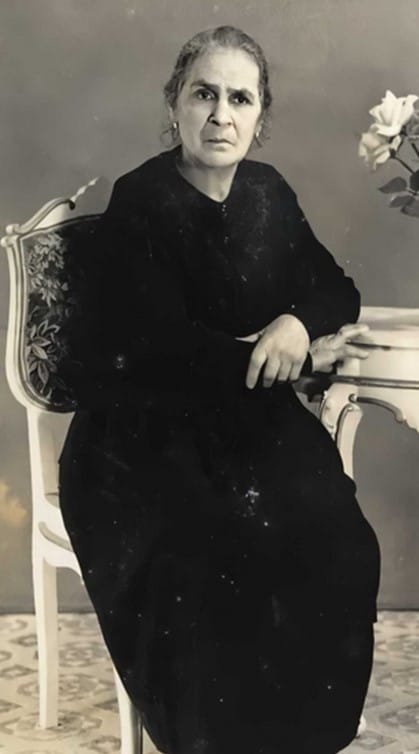
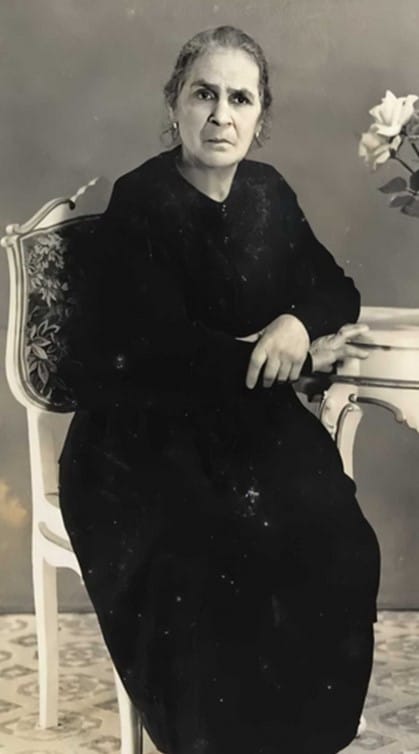
The portrait shown above is likely the only extant photograph of Maria and was probably taken in the 1950s, when she was in her fifties. There is no way to tell exactly where the picture was taken, nor for what reason.
It is impossible to tell for certain whether this picture was cropped, or whether another person may have been seated on the other side of the table, just past the flowers.
Maria herself is largely unadorned. She is wearing a very plain front-buttoned dress and has earrings. There may be a ring on her finger, where her hand is resting on the table, but it’s hard to see. Her dress appears quite long, the length perhaps reaching her feet. Based on her seated position relative to the back of the chair, she is likely over 5 ft (1.52 m) – 5 ft 5 in (1.65 m) tall, but no more than that. Probably average for the time. She does not appear heavy-set; in fact you can just make out the back of the chair through a gap hear her waist. So, she is rather slim in build.
Unsmiling, her face stares back at us from decades in the past. Her hair, dark and shot through with white or grey, appears pulled back. Perhaps it is long.
There are deep lines running from her nose to her lips. We euphemistically call these “laugh lines”, and perhaps Maria did laugh and smile a great deal. Perhaps not.
Her dark brown eyes are deep-set, with dark skin around them. Perhaps this darkness comes from age, or perhaps she is simply very tired.
What We Know About Maria’s Original Family
Marie was born around 1895 in Povoação, on the island of São Miguel in the Azores. Her parents were Jose Mestro De Rezendes and Francisca Ferreira, both of whom were from São Miguel and who may have been born around 1850. One of possibly twelve children, Maria’s siblings were:
Maria Dos Anjos (b. 1876); Ernesto (b. 1887); then Olinda, Pedro, Alverinho, Jose, Ilda, Belmira, Angelina, Ermilinda and Francelina (all likely born between 1876 and 1895).
Nothing more is known about Maria’s parents or siblings.
Maria Marries
Although there is no record of her marriage, marry she did, to a man named Francisco Correia Da Ponte (b. May 29, 1886). Franscisco came from a large family as well; he was the eighth of eleven children.
The couple had five children in quick succession: Miguel or Manuel(b.1915), Maria Resendes(b. 1916), Olinda Resendes(b. 1917), Angelina Resendes(b. 1919),and lastly Honorina Resendes(b. 1920).
All the girls would leave the Azores, probably after the death of their father in 1942.
Her daughter, Maria, would immigrate to Brazil, and all the other daughters left for Canada settling down in Toronto, Ontario.
“Our” Maria had several grandchildren, most of whom were born in the Azores between 1945 and 1950. None returned to the island, other than perhaps for a visit or two.
Did Maria ever visit her daughters? We can’t know for sure, but there do appear to be records of her having gone for a time to Brazil. For how long we don’t know. Perhaps the photograph was taken there in honour of her visit. A picture of grandma for the distant family to keep and cherish.
The Azores: The Land That Shaped Maria
Without going too deeply into the general history of the Azores, it is worth noting that its history (at least in terms of European history) begins in the 15th century when the Portuguese began charting and exploring off the west coast of Africa. It may have begun even earlier, as there are maps from as early as 1373 that reference these islands.
In any case, despite the details being somewhat murky, it seems accurate to say that the islands of Santa Maria and São Miguel were initially explored with an eye towards settlement around 1425 and by 1470 the first village, Anjos on Santa Maria, was established.
The Azores appear in the record books from then on. Of note is the landing of Columbus’ ship the Nina, seeking repair work which was completed on São Miguel. It is very possible that Maria’s ancestors witnessed the arrival of Columbus, but who knows if they even cared, if it was yet just another ship pulling into port. Little did they know that they were witnessing an event that would change the world forever.
São Miguel was colonized in 1432 at the site of Povoação, Maria’s home town. It quickly became the centre of activity for all the Azores. It had a thriving business in cultivating oranges. In fact, in the mid-19th century, São Miguel was the largest exporter to oranges to England, and the east side of the island was covered in orange groves.
Sadly, a disease (known more generally as the Great French Wine Blight) decimated the entire orange crop and most of the vineyards in the late 1800s, so Maria would not have known breezes wafting the perfume of oranges, but her parents would have.
The Ethnic Makeup of São Miguel
Genetic studies have been conducted on the population of the Azores. Referencing the Y Chromosome (from the male line), nine different haplogroups have been identified; most of which are common in Europe. The most common haplogroup is “J”, being of 13.4% of Azoreans, but is much less frequent in mainland Portugal (only 6.8%).
Other haplogroups found in the Azores but almost never in Portugal are prevalent in Asia and sub-Saharan Africa.
On the mothers’ side, the majority of mtDNA originates from the Iberian Peninsula and predominately from Portugal.
Interestingly, the greater presence of Moorish and African mtDNA is found in the São Miguel and Eastern areas of the islands, which would correspond to the larger concentration of slaves brought there (as opposed to other areas of the Azores).
As there is no information at the moment on the DNA of the descendants of Maria, we cannot know if her ancestors were predominantly from mainland Portugal or from Africa.
Disasters
Throughout the centuries, the Azores and São Miguel have seen more than their fair share of natural disasters.
Within the living memories of Maria’s families, some of these events would resonate and likely be told to children and through reminiscences:
- In 1811, a volcanic eruption occurred at the shore at Ferraria, São Miguel, and it created a short-lived island which was named Sabrina Island. The islet sank back into the sea in a few years. The eruption destroyed many homes.
- In 1848 an earthquake hit, but caused no deaths in São Miguel.
- In 1852 another earthquake hit the area and damaged homes.
- By the time Maria was a child, in 1907, she would have been witness to the aftermath of an underwater eruption at the Monico Fracture. On April 1, the eruption involved a radius of 300 m just south-southwest of São Miguel. It spewed out ashes from the waters onto the land.
- In 1911 there was another underwater eruption in the same area.
These are only a few of the disasters that struck the Azores more generally. Volcanic eruptions, earthquakes, hurricanes…. Maria would have seen the effects of many during her lifetime.
Birds and Animals Maria Would Have Known
The Azores are home to very few “exclusive” species, but there is a bullfinch that is found only on São Miguel that is now critically endangered. It has a short distinctive song, something like a flute or a whistle, and it is likely that Maria would have heard this melancholic call.
There is only one endemic mammal: the Azores Noctule. The Noctule is a bat and is highly unusual because it hunts insects during the day. Almost certainly Maria would have known about this creature.
The Perfume of Maria’s Life
Smells have the power to transport us back to the past, to places we are deeply connected to. Maria’s world would have been scented by the humid salt air of the sea, the lush green aroma of the flora, sweet notes of flowers, and all tinged with a volcanic whiff of sulphur. Rich, earthy, pungent and sweet.
The Folklore of Maria’s World
The Azores are rich in stories and Povoação, in particular, has some intriguing tales. Maria would certainly have heard these legends and may have told them to her children.
The Legend of the Goat
This story recalls the arrival of the settlers in Povoação. It relates when the newcomers arrived in the area, they tied a goat to a stake as a test for the safety of the island. They returned after a few days to where the goat had been tied; it was found alive, and this meant that the island was indeed safe.
The Legend of Nossa Senhora da Enxara
A young girl was playing near a river where she met a beautiful lady who gave her a gold earring. When the girl told her mother about what had happened, the mother followed the girl back to the place where she met the lady, and there found the image of the Virgin Mary on a stone. Excited villagers then moved the stone to a nearby chapel, but the stone kept returning to its original spot, which the people took to mean that the Virgin wanted a chapel to be built there.
The Legend of the Furnas Lagoon
The Legend of the Furnas Lagoon (in Povoação) speaks of a wealthy village that was swallowed by the earth, with only a lagoon remaining in its place. There were two survivors — a boy and his grandfather escaped death because they had noticed the nearby spring water had become salty, and so suspected a disaster was about to occur.
The Legend of Euphemia
The Legend of Euphemia tells of the daughter of the Greek God Atlas. According to Greek legend, Euphemia was the most beautiful of Atlas’ daughters. The other daughters, commonly known as the Pleiades (Maia, Electra, Taygete, Celaeno, Alcyone, Sterope, and Merope), found their way into the heavens to be forever pursued, but never captured, by the hunter Orion. However, the Azorean myth tells a different story. Euphemia was one of fifteen sisters and was to be married to a son of Neptune. But Neptune went to war with Atlas and during the war Euphemia died. When she found herself in the afterlife, she converted to Christianity and would appear on earth to proselytize her newfound faith.
In São Miguel, it is said she lives in the “boiler” or valley of the volcano that gave birth to the Seven Cities, and that her abode appears and disappears amidst clouds and mists.
Not particular to Povoação, but well known throughout the Azores, are some other fascinating stories.
The Legend of the Seven Cities’ Lagoons
Many years ago, around the area of the Sete Cidades parish, there lived a beautiful blue-eyed princess named Antilia. The girl enjoyed walking through the kingdom and one day met a green-eyed shepherd. The two often walked together and fell in love. Antilia’s father, the king, was displeased when he learned of Antilia's lowly companion and forbade her to see him again. She begged her father, asking to see her love one last time. Taking pity on his daughter, he agreed that they could have one final walk together. When the two met, they both cried so hard and for so long that their tears ran down the valley; Antilia’s tears formed a blue lagoon, and those of the shepherd a green one. And so to this day, there are two lagoons in the mountains, always close but never touching.
The King and the Disappearing Island
According to legend, there used to be a mysterious island where there lived a bitter and cruel king. He had become that way because he was unable to have children.
One night, he looked into the sky and watched as a star came down from the heavens. It turned into a lovely woman. This star-woman told the king he would indeed have a daughter — as beautiful as the sun — but he had to do a few things first. He had to stop being cruel and become a patient man. Furthermore, he was to build a palace among seven cities, and these cities were to be surrounded by insurmountable bronze wells. And within this palace he must keep the princess away from everyone for 30 years, and not even he could see her.
The lady from the sky warned the king: If he did not follow her conditions, he would die, and his kingdom would be destroyed.
Despite these dire warnings, after 28 years of not seeing his daughter, the king could no longer resist, and he tore down the walls. As soon as the walls came down, the earth began to shake, and the island sank forevermore into the sea.
The Mistérios
The last legend related here is that of the Mistérios. These creatures are the spirits of those who lived in the islands that were wronged or died tragically.
The Mistérios are pale, ghostly and appear in the middle of the night. Roaming the islands, they seek justice or revenge, and anyone who crosses their path must be wary of looming misfortune or an impending death.
Maria is no More
There does not appear to be a verifiable record of Maria’s death, nor confirmation of her final resting place. All that seems to be said is that she died sometime in 1963, still in the Azores. She would have been 68 years old.
Maria is now a figure lost to time, and she has slipped through the world, now unseen.
Although it is a pity not to have more information about Maria, what we do know is that her legacy has touched two other continents; her spirit still flows through the world, more than a century after her birth.
And so we remember and honour Maria do Espirito Santo Ferreira Rezendes.